Work in progress

PLP Graduate Forum Seminars

Through the year the Forum runs a seminar series in which a graduate student presents work in progress and receives responses from an academic commentator and a student commentator, followed by open discussion. Sessions run in person and online, and rotate among the member institutions.

Current series (2025–2026)

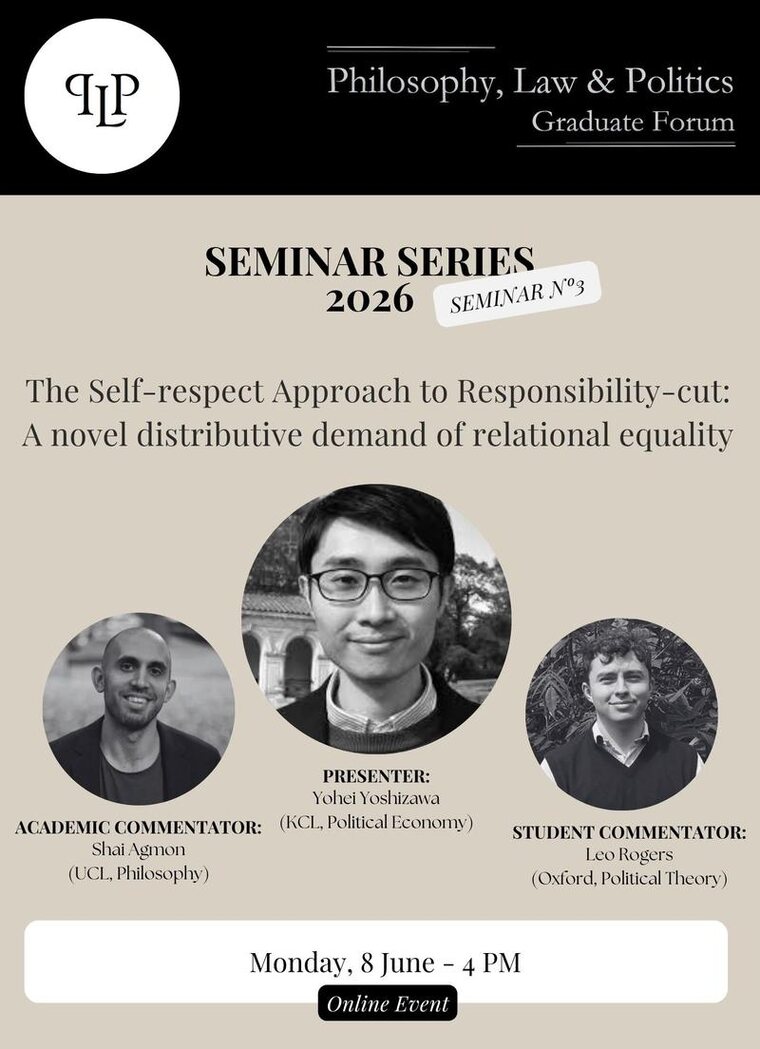
Poster for “The Self-Respect Approach to Responsibility-cut: A Novel Distributive Demand of Relational Equality”
Yohei Yoshizawa (KCL, Political Economy)
The Self-Respect Approach to Responsibility-cut: A Novel Distributive Demand of Relational Equality
Academic commentatorShai Agmon (UCL, Philosophy)Student commentatorLeo Rogers (Oxford, Political Theory)
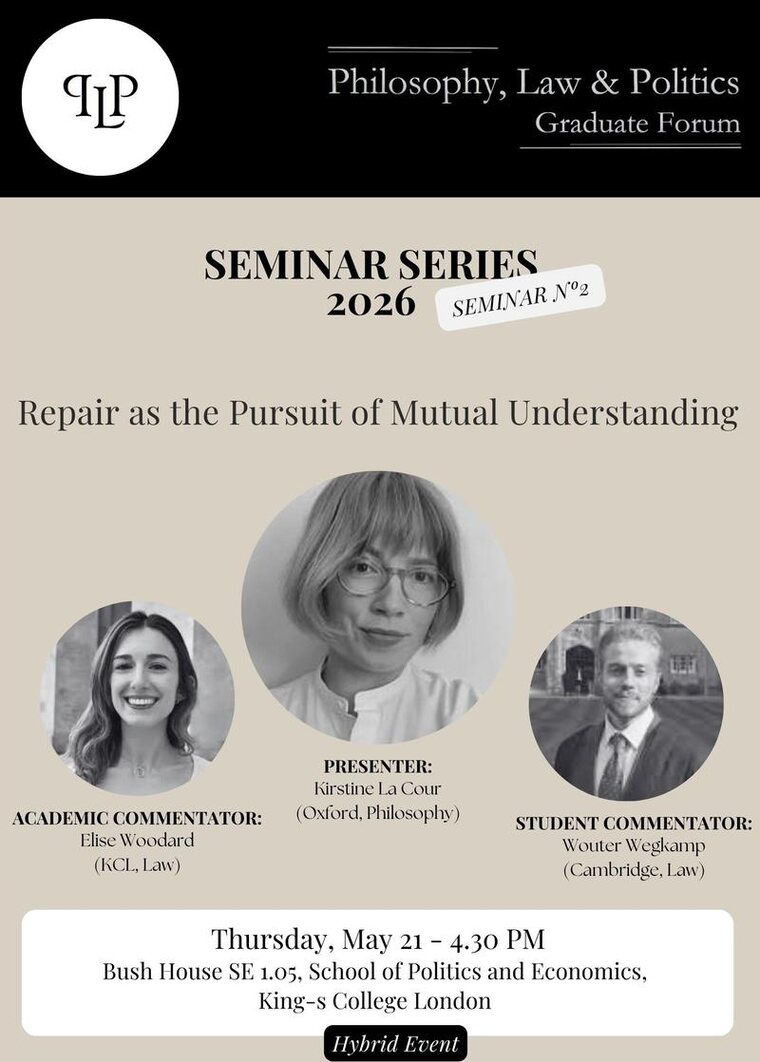
Poster for “Repair as the Pursuit of Mutual Understanding”
Kirstine La Cour (Oxford, Philosophy)
Repair as the Pursuit of Mutual Understanding
Academic commentatorElise Woodard (KCL, Law)Student commentatorWouter Wegkamp (Cambridge, Law)
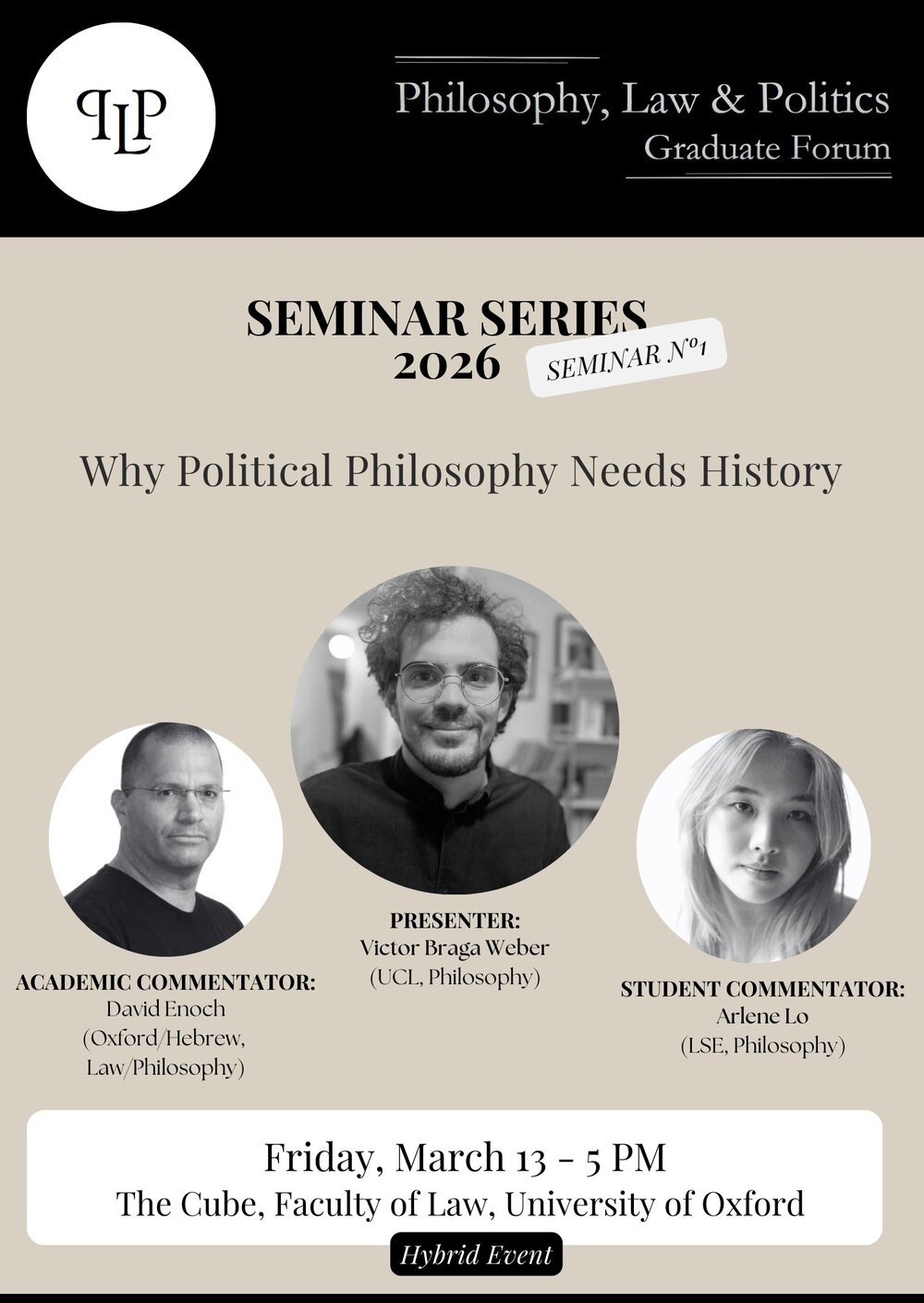
Poster for “Why Political Philosophy Needs History”
Victor Braga Weber (UCL, Philosophy)
Why Political Philosophy Needs History
Academic commentatorDavid Enoch (Oxford)Student commentatorArlene Lo (LSE, Philosophy)

Seminar archive

2024–2025

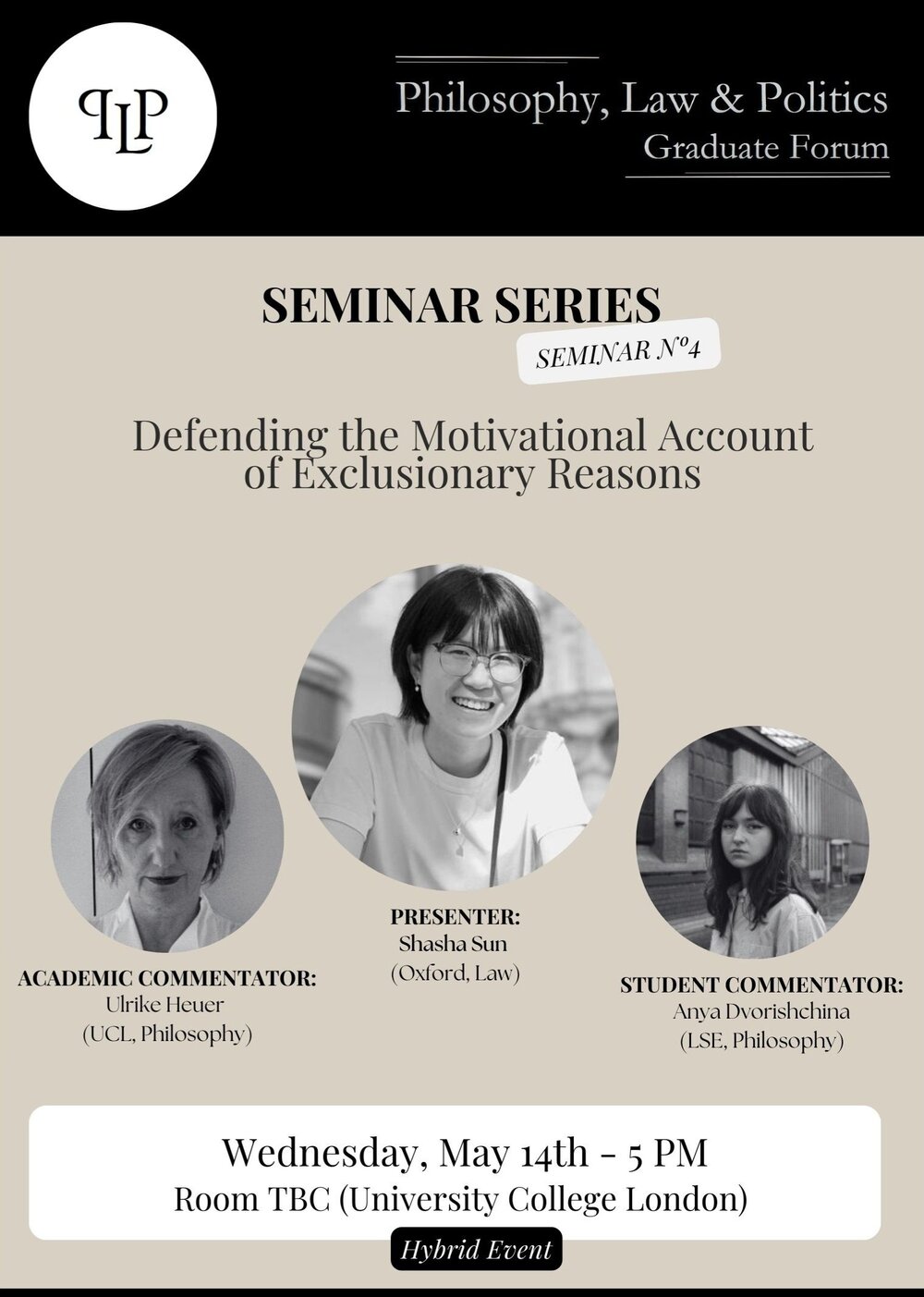
Poster for “Defending the Motivational Account of Exclusionary Reasons”
Shasha Sun (Oxford, Law)
Defending the Motivational Account of Exclusionary Reasons
Academic commentatorUlrike Heuer (UCL, Philosophy)Student commentatorAnya Dvorishchina (LSE, Philosophy)
According to Raz, an exclusionary reason is a reason not to act for certain reasons. The concept plays a significant role in explaining authoritative directives and in elucidating the nature of decisions, obligations, and rules in general. Yet many theorists challenge the existence of exclusionary reasons, arguing that one cannot refrain from acting for a reason for an exclusionary reason. This paper defends the existence of exclusionary reasons understood in the motivational sense and shows how, on this account, such reasons can appropriately guide agents’ actions: they guide by directing agents to act for the right reasons, and agents comply by exercising epistemic guidance control over their beliefs and motivations.
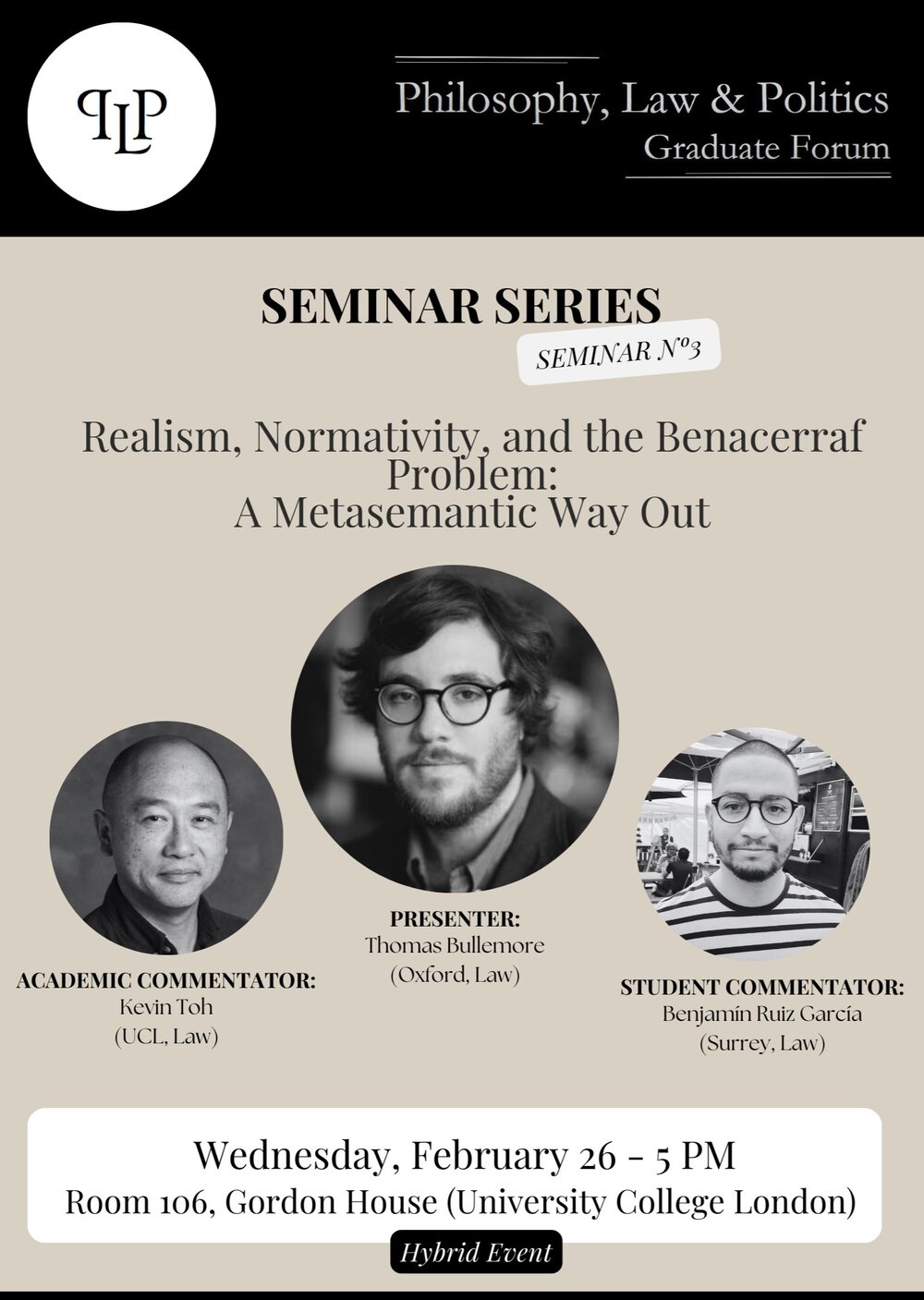
Poster for “Realism, Normativity, and the Benacerraf Problem: A Metasemantic Way Out”
Thomas Bullemore (Oxford, Law)
Realism, Normativity, and the Benacerraf Problem: A Metasemantic Way Out
Academic commentatorKevin Toh (UCL, Law)Student commentatorBenjamín Ruiz García (Surrey, Law)
This paper argues that normative realism faces a characteristic set of underdetermination puzzles that question the possibility of ascribing determinate and stable contents to normative predicates. Failure to meet these challenges undermines the theory’s semantic plausibility and carries revisionary consequences for its metaphysics. The paper identifies and articulates some salient semantic challenges facing normative realism, discusses a prominent metasemantic solution advanced on its behalf, and assesses the merits of that solution.
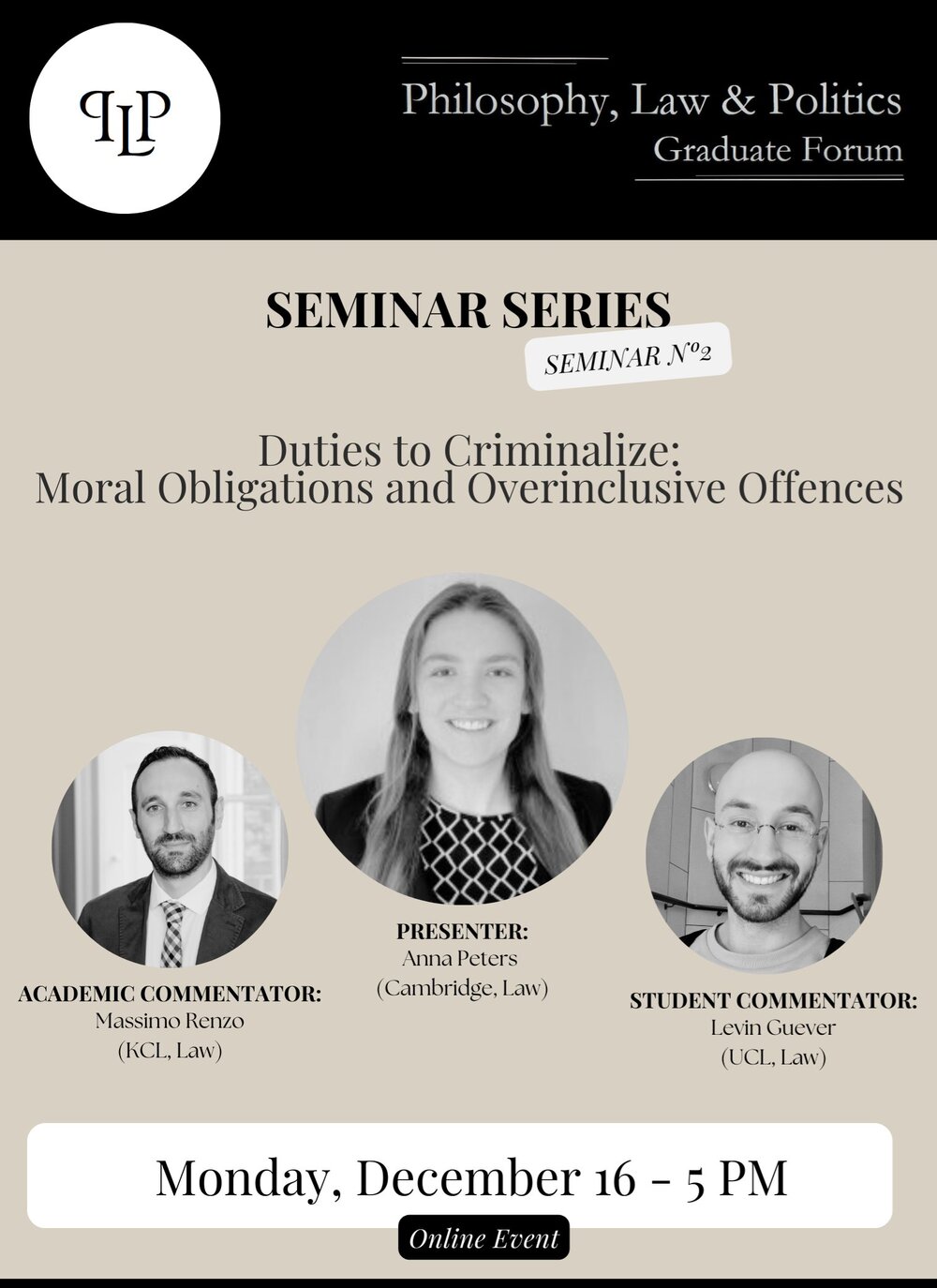
Poster for “Duties to Criminalize: Moral Obligations and Overinclusive Offences”
Anna Peters (Cambridge, Law)
Duties to Criminalize: Moral Obligations and Overinclusive Offences
Academic commentatorMassimo Renzo (KCL, Law)Student commentatorLevin Guever (UCL, Law)
This paper argues that states bear duties to criminalize certain moral wrongs because they are obligated to uphold individuals’ rights. Given epistemic limits and resource constraints, some of these wrongs must be criminalized overinclusively — proscribing acts only some tokens of which cause, or threaten to cause, the wrong the law targets — if they are to be criminalized substantively. Legal officials therefore bear moral duties to implement overinclusive offences, contrary to the wrongness constraint.
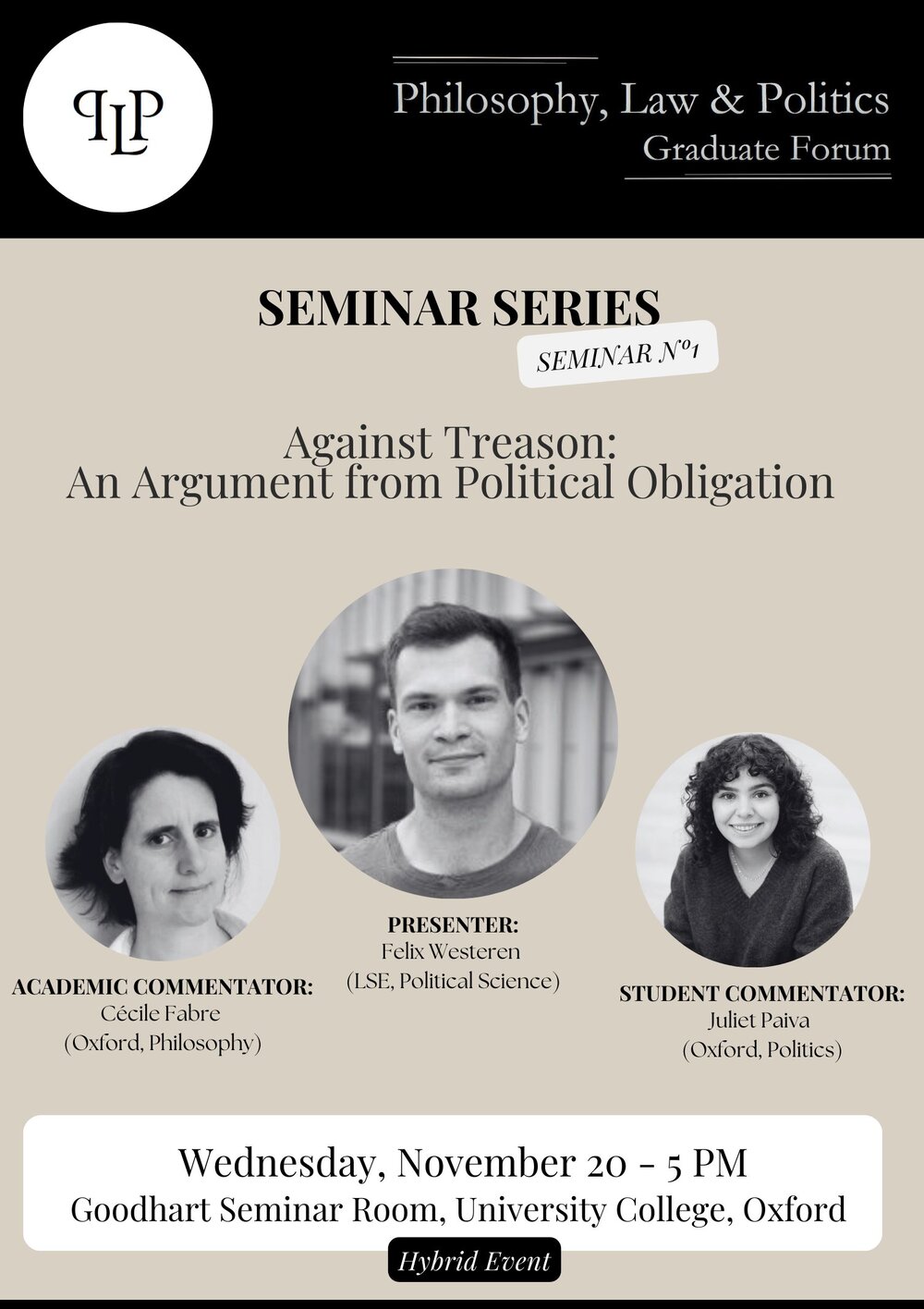
Poster for “Against Treason: An Argument from Political Obligation”
Felix Westeren (LSE, Political Science)
Against Treason: An Argument from Political Obligation
Academic commentatorCécile Fabre (Oxford, Philosophy)Student commentatorJuliet Paiva (Oxford, Politics)
This paper locates the distinct moral wrong of treason in the undermining of the ability of the traitor and their co-nationals to fulfil political obligations. Against scepticism about treason as a distinctive wrong, and without relying on the intuitive idea that treason involves a betrayal, it argues that on several attractive non-anarchist accounts of political obligation treason is distinctively and seriously wrong because it undermines our ability to fulfil important political obligations, and it draws out some implications of this view.

2023–2024

Poster for “Uncertain Action”
Pablo Hubacher Haerle (Cambridge, Philosophy)
Uncertain Action
Academic commentatorMark Dsouza (UCL, Law)Student commentatorLuiza Tavares (Queen Mary, Law)
It is a common idea in the theory of action that in order to act intentionally, the agent needs to know why they act (Anscombe, 1957 and her contemporary followers). In this essay, I argue for a novel challenge to this doctrine. Some of our intentional actions are uncertain, i.e., done without knowing why we’re acting. I discuss various ways of resolving this tension arguing that they all fail. Knowing-why and acting intentionally respond differently to contextual features such that we can act intentionally without knowing why.
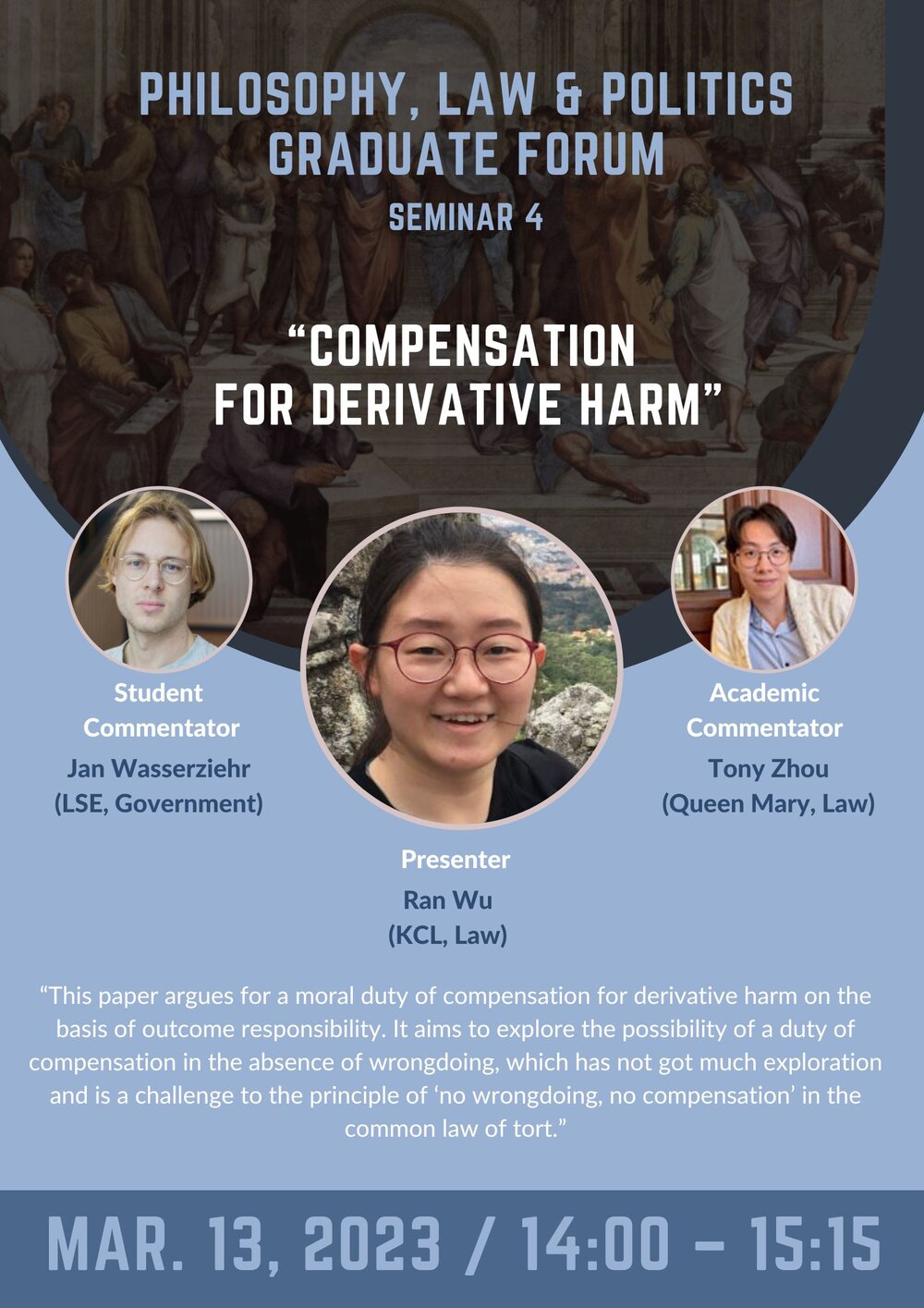
Poster for “Compensation for Derivative Harm”
Ran Wu (KCL, Law)
Compensation for Derivative Harm
Academic commentatorTony Zhou (QMUL, Law)Student commentatorJan Wasserziehr (LSE, Government)
This paper argues for a moral duty of compensation for derivative harm on the basis of outcome responsibility. It aims to explore the possibility of a duty of compensation in the absence of wrongdoing, which has not got much exploration and is a challenge to the principle of ‘no wrongdoing, no compensation’ in the common law of tort.
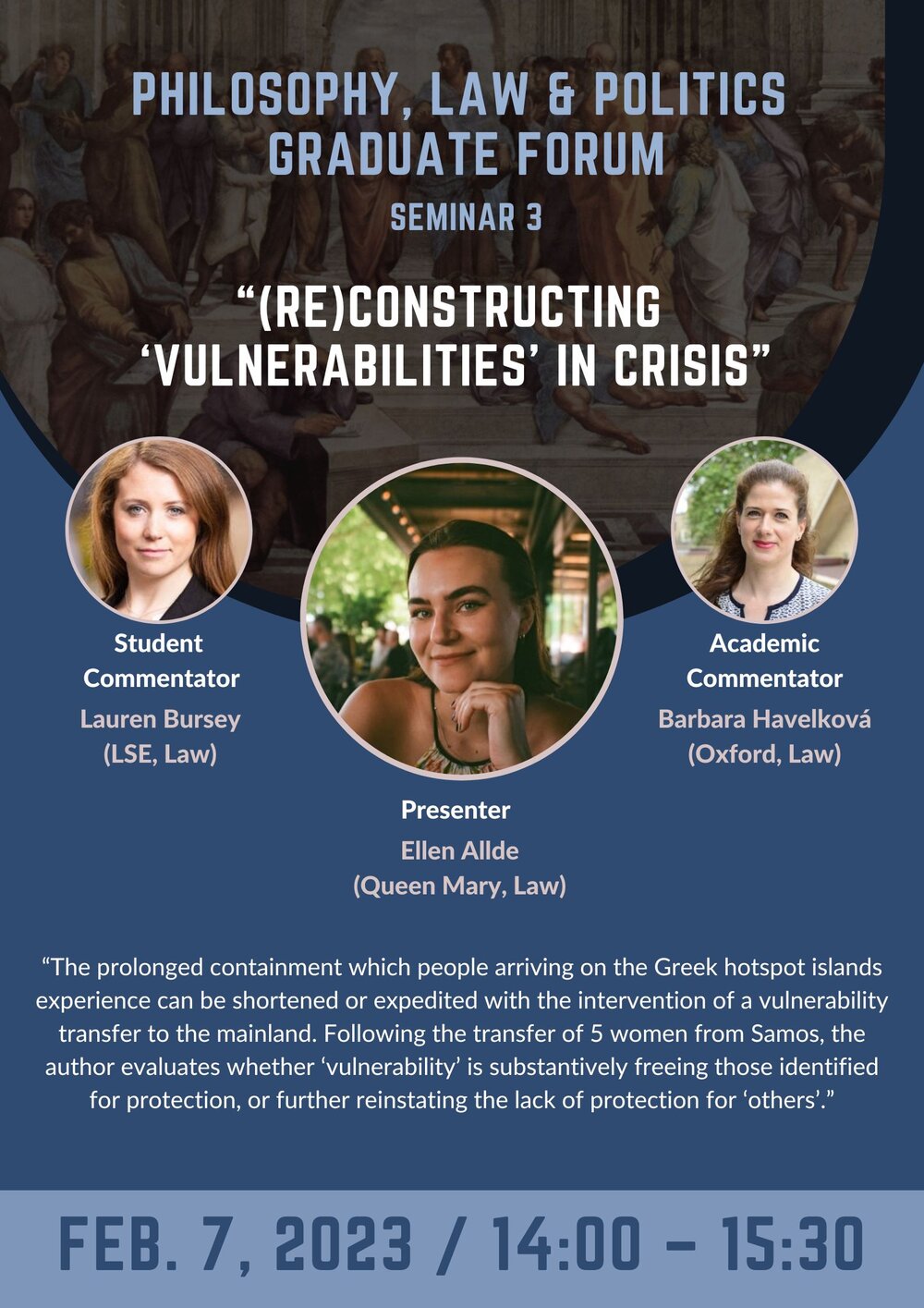
Poster for “(Re)constructing ‘Vulnerabilities’ in Crisis”
Ellen Allde (Queen Mary, Law)
(Re)constructing ‘Vulnerabilities’ in Crisis
Academic commentatorBarbara Havelková (Oxford, Law)Student commentatorLauren Bursey (LSE, Law)
The prolonged containment which people arriving on the Greek hotspot islands experience can be shortened or expedited with the intervention of a vulnerability transfer to the mainland. Following the transfer of five women from Samos, the author evaluates whether ‘vulnerability’ is substantively freeing those identified for protection, or further reinstating the lack of protection for ‘others’.
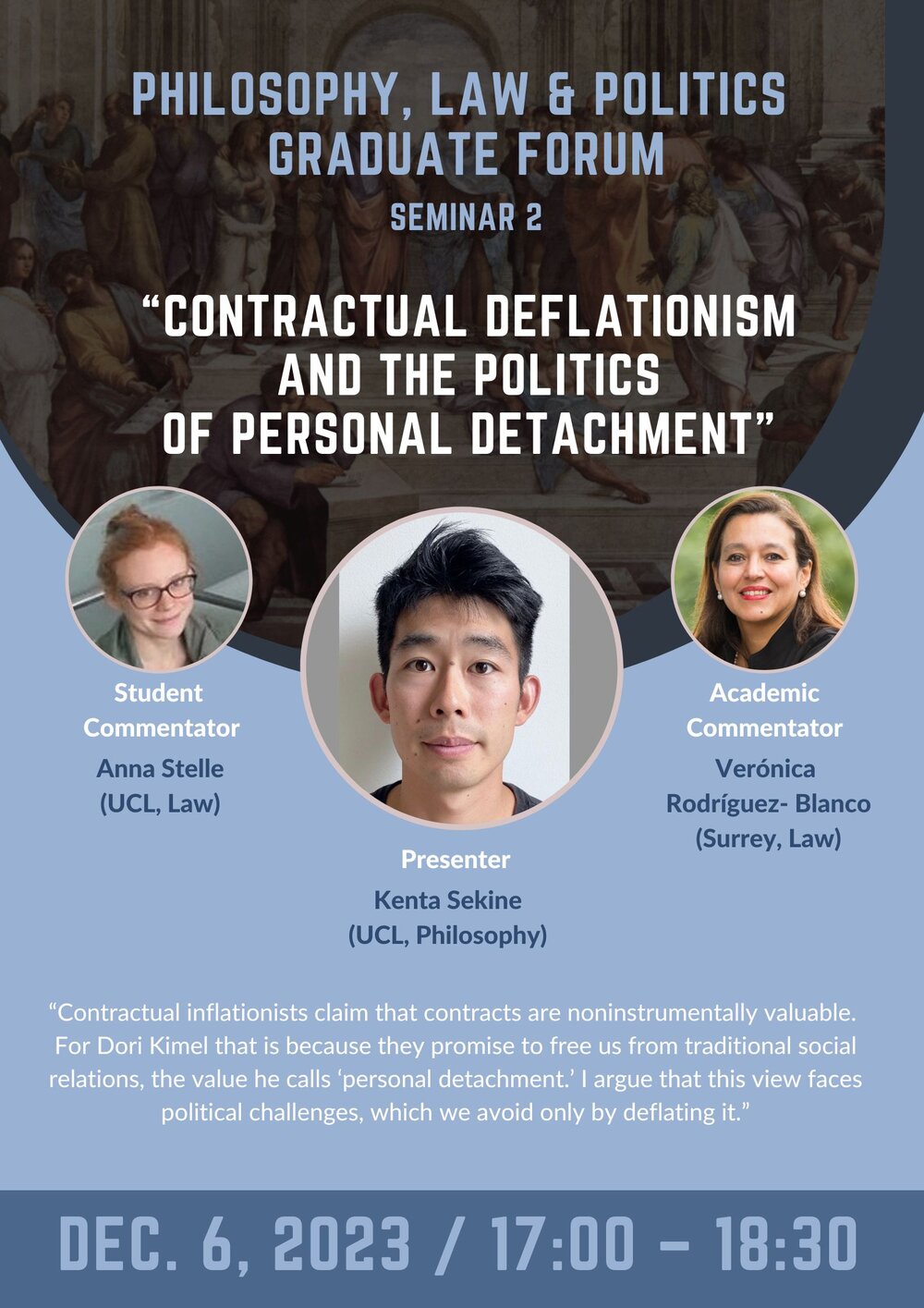
Poster for “Contractual Deflationism and the Politics of Personal Detachment”
Kenta Sekine (UCL, Philosophy)
Contractual Deflationism and the Politics of Personal Detachment
Academic commentatorVerónica Rodríguez-Blanco (Surrey, Law)Student commentatorAnna Stelle (UCL, Law)
Contractual inflationists claim that contracts are noninstrumentally valuable. For Dori Kimel that is because they promise to free us from traditional social relations, the value he calls ‘personal detachment’. I argue that this view faces political challenges, which we avoid only by deflating it.
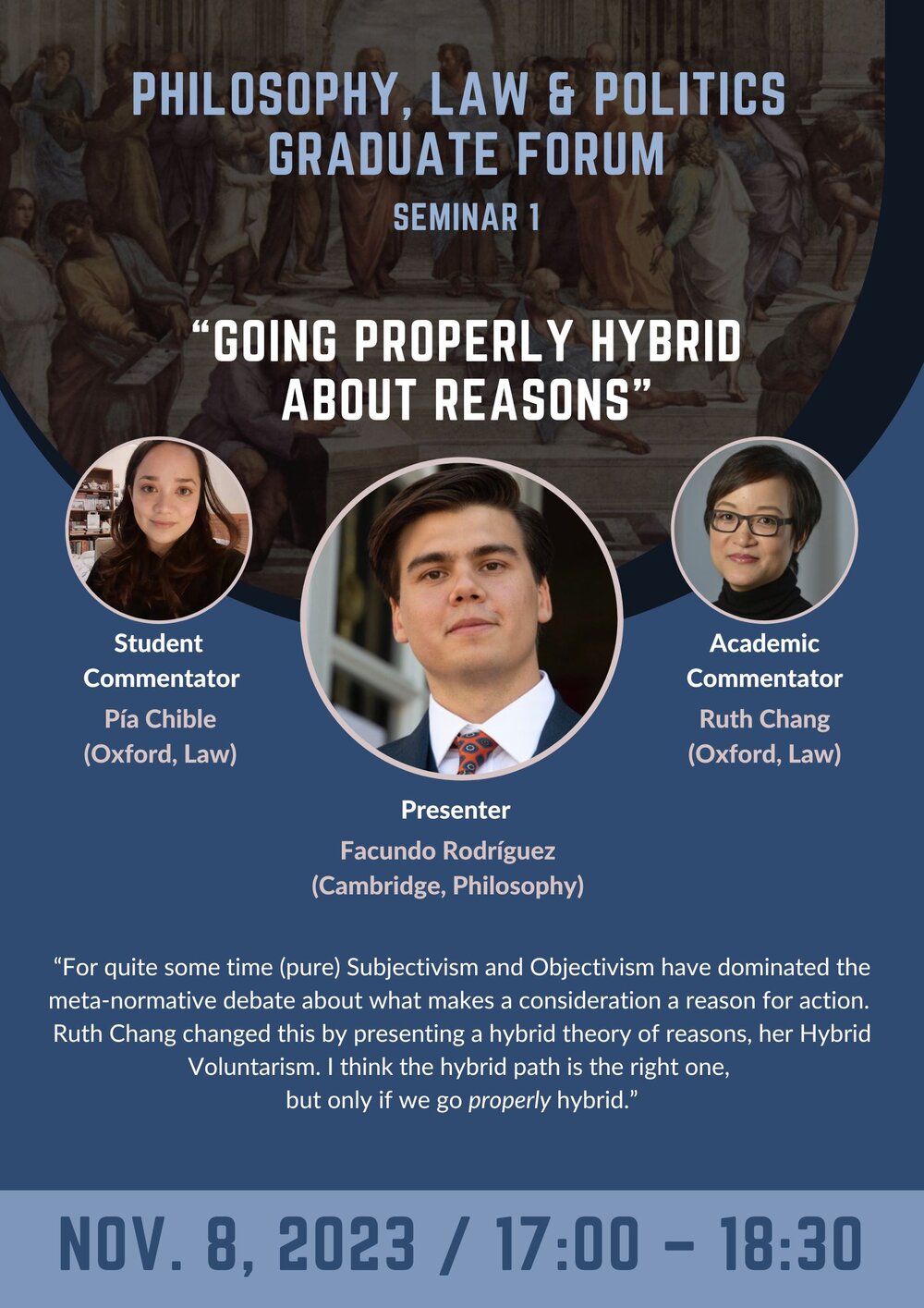
Poster for “Going Properly Hybrid About Reasons”
Facundo Rodríguez (Cambridge, Philosophy)
Going Properly Hybrid About Reasons
Academic commentatorRuth Chang (Oxford, Law)Student commentatorPía Chible (Oxford, Law)
For quite some time (pure) Subjectivism and Objectivism have dominated the meta-normative debate about what makes a consideration a reason for action. Ruth Chang changed this by presenting a hybrid theory of reasons, her Hybrid Voluntarism. I think the hybrid path is the right one, but only if we go properly hybrid.

2022–2023

Kim Leontiev
Kim Leontiev (UCL, Philosophy)
Legal Exemptions for Religious / Conscientious Reasons
Academic commentatorPaul Billingham (Oxford, Politics & IR)Student commentatorJingzhi Chen (Oxford, Law)
Anna Bartsch (Oxford, Philosophy)
Taking a Cut: Resale Rights
Academic commentatorSarah Fine (Cambridge, Philosophy)Student commentatorAnna Stelle (UCL, Law)
Ira Chadha-Sridhar
Ira Chadha-Sridhar (Cambridge, Law)
The Concept of Care: A Thick Concept
Academic commentatorJonathan Herring (Oxford, Law)Student commentatorAnna Milioni (KCL, Philosophy)
Max Afnan
Max Afnan (LSE, Government)
Must Global Democracy be Liberal?
Academic commentatorAndrea Sangiovanni (KCL, Philosophy)Student commentatorFilippa Ronquist (UCL, Philosophy)
Andrew Field
Andrew Field (Surrey, Law)
Criticisms of the Quarantine Model of Criminal Punishment
Academic commentatorMaría Álvarez (KCL, Philosophy)Student commentatorDaniel Peixoto Murata (Surrey, Law)
Sonia Cruz Dávila
Sonia Cruz Dávila (KCL, Law)
Unilateral Executive Power: What is It and What is Wrong with It?
Academic commentatorJeff King (UCL, Law)Student commentatorVincent Harting (LSE, Government)

2021–2022

Rachel Erin Frith
Rachel Erin Frith (Queen Mary)
Theorising the Role of the Law in the Constitution of Social Identities for Trans- and Non-Binary Parents
Academic commentatorBarbara Havelková (Oxford)Student commentatorAnna Milioni (KCL)
Jonas Haeg
Jonas Haeg (KCL)
What do We Owe to Aggressors?
Academic commentatorCécile Fabre (Oxford)Student commentatorPenny Oderberg (Queen Mary)
Daniela Gueiros-Dias
Daniela Gueiros-Dias (Cambridge)
Normative Conflicts in the Legal Domain
Academic commentatorChristoph Kletzer (KCL)Student commentatorStephanie Classmann (LSE)
Cain Shelley
Cain Shelley (LSE)
Justice & Class Consciousness: Towards a Theory of Political Transition
Academic commentatorDavid Miller (Oxford)Student commentatorSonia Cruz Dávila (KCL)
Jeevan Hariharan
Jeevan Hariharan (UCL)
Privacy, Damages and the Concept of Loss
Academic commentatorSandy Steel (Oxford)Student commentatorForest Yu (Cambridge)
Calvin Chan
Calvin Chan (Oxford)
Normative Powers: Realism, Reductionism, or Eliminativism
Academic commentatorNoam Gur (Queen Mary)Student commentatorFilippa Ronquist (UCL)
Daniel Peixoto Murata
Daniel Peixoto Murata (Surrey)
Truth-Telling, Promises and the Shape of a Character
Academic commentatorDori Kimel (Oxford)Student commentatorCalvin Chan (Oxford)